
The healthcare business is evolving at a greater pace than ever before. Providers are facing rising administrative costs, more complex insurance billing, staffing constraints, and rising patient expectations that are leading them to reconsider how they manage their financial operations.
Touchless Revenue Cycle Management will be one of the largest transformations in healthcare finance in 2026.
Traditional billing systems usually involve a lot of manual labor. Staff workers spend hours checking insurance coverage, revising refused claims, inputting billing data, posting payments, and talking with insurance companies.
These repeated tasks slow reimbursement and raise operational pressure across healthcare businesses.
Providers are migrating to automated solutions today that minimize manual intervention and maximize efficiency and accuracy of reimbursement.
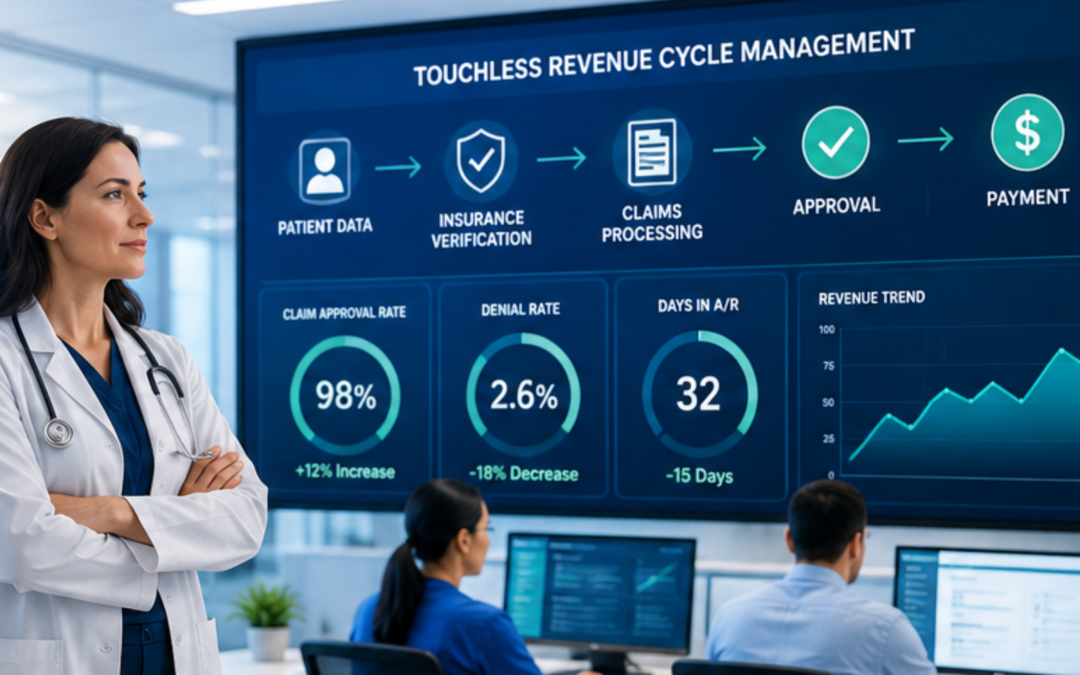
Touchless revenue cycle management is catching on fast. It’s a smarter, more efficient approach to healthcare billing. Instead of relying on manual work, it uses automation, AI, predictive analytics, and real-time workflows to make the entire billing process smoother.
Healthcare groups are jumping in because automation helps them save money, nail claim accuracy, keep denials down, and strengthen their financial outcomes.
Companies like Total Medx are stepping up, helping providers modernize their billing with advanced automation. Their aim: better revenue, now and down the line.
If healthcare providers want to stay ahead in an industry that never stops shifting, they need to understand how Touchless Revenue Cycle Management is taking over.
What Is Contactless Revenue Cycle Management?
Touchless Revenue Cycle Management is the concept of employing advanced automation solutions to enable healthcare billing procedures to be conducted with minimal manual intervention.
Touchless solutions automate several elements of the revenue cycle so workers aren’t required to manually perform every billing activity. Artificial intelligence and machine learning technology evaluate billing data, find problems, process claims, and track reimbursement activity in real-time.
This new-age technique increases efficiency in healthcare billing operations and lightens the load on the administrative staff. Typical uses of touchless systems include:
- Verification of insurance
- Medical coding
- sanitation claim
- Management of Denial
- Payment processing A/R follow-up
- Patient billing Revenue analysis
The aim is to enhance billing performance and reduce delays and administrative inefficiencies.
Why Automation is Becoming Mainstream for Providers
Healthcare providers are feeling the squeeze. The need to boost their finances keeps growing, but so do their day-to-day headaches.
Take billing, for example. Old systems rely on tons of manual work, which just slows things down and opens the door for mistakes. Plus, payers are throwing more complex requirements into the mix every year, so those old manual processes just aren’t cutting it anymore.
Automation helps organizations keep up and stay accurate, so it’s not surprising that more providers are making the switch. That’s part of the reason billing automation is such an important healthcare trend for 2026.
Providers are adopting automation because it helps improve:
- Rightness of claim
- Speed of workflow
- Productivity of the personnel
- Payment time
- Operational efficiency
Automation also cuts down on the repetitive admin activities that lead to staff burnout and delays in billing. Healthcare providers are discovering that today’s financial operations need more intelligent tools to handle increasing billing complexity more efficiently.
Artificial Intelligence Transforms Revenue Cycle Management
Artificial Intelligence is an integral part of the evolution of Touchless Revenue Cycle Management.
AI-enabled systems are capable of analyzing hundreds of thousands of healthcare billing data points in seconds and can detect problems before they cause claim denials or delayed payments.
Unlike traditional billing software, AI systems continue to learn from previous billing patterns and reimbursement trends. This enables healthcare institutions to improve their billing accuracy over time.
AI technology serves numerous critical revenue cycle management areas:
- Predictive Modeling
- Avoidance of claim denials
- Claims review automation
- Code Completions
- Eligibility Check Revenue Forecast
AI is helping providers tighten overall financial performance by decreasing human error and enhancing operational efficiency.
Need For Touchless Systems Driven By Claim Denials
One of the major drivers for providers to embrace touchless billing systems is the ongoing rise in claim denial rates. There are significant financial consequences for healthcare organizations when claims are denied, resulting in payment delays and increased administrative burden.
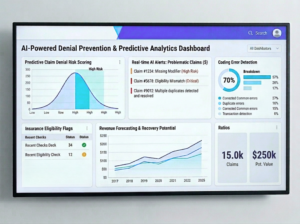
Many billing teams spend endless hours fixing denied claims and handling payer appeals. Touchless systems assist in minimizing denials by detecting billing errors prior to a claim submission.
Automated claim scrubbing technology can instantly identify:
- Inconsistency in coding
- Missing modifiers
- Inaccurate data about patients
- Authorization issues
- Lack of documentation
- Duplicate claims.
This proactive strategy improves clean claim rates and decreases the amount of rework after submission. Healthcare providers focusing on denial prevention versus denial rectification are experiencing higher reimbursement performance and cash flow.
Real-Time Insurance Verification Increases Billing Accuracy
Yet, there are still many claims refused each year because of insurance eligibility difficulties. There is often scope for error in manual eligibility checking processes in:
- Status of Coverage
- Amounts deductible
- Changes in policy
- Authorization requirements
- Copayment Information
Touchless revenue cycle systems use automated insurance verification technologies to verify patient coverage in real-time before appointments happen.
With better tools, providers can spot problems sooner and stop billing headaches before they happen. When you get billing right upfront, hospitals see fewer claim denials, and patients have a smoother financial process. It’s just less stress all around.
Healthcare Automation Grows Amid Staff Shortages
Lately, automation in healthcare is really taking off, and it’s not hard to see why. Staff shortages are hitting hospitals hard, and it looks like they’ll still be a big challenge in 2026.
Billing teams everywhere are stretched thin. Work keeps piling up, but the number of people handling it just isn’t enough. On top of that, insurance rules are getting more complicated, and it’s tough for admin teams to keep up.
This is making automation in healthcare more crucial than ever before. Touchless revenue cycle systems ease administrative burdens by automating repetitive billing tasks like:
- Claim tracking
- Posting of payments
- Billing reminders
- Follow up on accounts receivable
- Qualification reviews
Automation frees up staff time for more sophisticated billing concerns and patient interactions instead of manual repetitive work. It increases productivity and allows firms to manage operating expenditures better.
Predictive Analytics Enhances Financial Decision-Making
Predictive analytics has become one of the most useful technologies in today’s healthcare billing system. Touchless revenue cycle technologies review billing data and reimbursement patterns to assist providers in making smarter financial choices.
How can predictive analytics aid a healthcare organization?
- Find denial patterns
- Reimbursement Trends Forecast
- Identify the slow payers
- Plug revenue leakage
- Enhance collection tactics
Most traditional billing systems offer only historical reporting. Modern touchless systems employ real-time financial data to help firms spot dangers before they become problems. This proactive approach improves operational visibility and long-term financial performance.
Touchless Revenue Cycle Management Enhances Patient Experience
Today’s patients want fast, easy, transparent healthcare billing experiences. As patient financial responsibility increases, healthcare providers need to improve communications and streamline payment processes.
Touchless billing systems enhance patient involvement by:
- Automated bill reminders
- Digital payment gateways
- Payment plans online
- Live billing updates
- More rapid financial communications
Easy-to-comprehend and readily available billing methods make it easier for patients to settle accounts quickly. Enhancing the patient financial experience also helps providers improve collections performance and patient happiness.
Automation is increasing the accuracy in medical coding
Accurate reimbursement, compliance, and accurate medical coding are all critical. Manual coding techniques can result in inconsistent coding, mismatches in documentation, and denials of claims. Touchless revenue cycle systems generally feature AI-assisted coding tools that help to increase coding accuracy and workflow efficiency.
These systems can enable:
- Coding ICD-10
- Coding (CPT
- Assignment of modifiers
- Review of documentation
- Coding for Compliance
Experienced coders are still incredibly vital, but automation allows coding teams to move faster and more consistently. Enhanced coding precision translates into improved reimbursement results and reduced denial rates.
Cash flow is boosted by faster payment processing
Traditional payment posting operations require a great deal of manual reconciliation of insurance payments and patient balances.
Touchless systems automate the posting of payments with sophisticated matching technology to improve the speed of processing and accuracy of accounts.
Faster payment processing is a boon for providers:
- Improve the cash flow
- Minimize posting errors
- Increase reporting accuracy
- Increase operating efficiency
Automation of payment operations gives healthcare firms more financial insight and shorter reimbursement cycles.
Compliance Monitoring is Getting Smarter
Regulations are changing, and healthcare billing compliance is becoming more complex. Insurance audits, coding upgrades, and HIPAA standards demand constant monitoring and management.
Touchless revenue cycle systems support compliance with automated monitoring technologies that can detect:
- Billing inconsistencies
- Coding irregularities
- Documentation hazards
- Potential audit triggers (HSE)
Automated compliance oversight assists healthcare firms in reducing financial risk and increasing billing accuracy.
Providers that improve compliance monitoring are more shielded from payment interruptions and regulatory penalties.
The Future of Revenue Cycle Management Without Touch
In the future, healthcare billing will become more automated and data-driven.
Healthcare organizations are likely to continue to invest in:
- AI
- Predictive Analytics
- Automating the revenue cycle
- Automated claims review
- Eligibility systems in real-time
- Smart denial prevention
With payer complexity continuing to grow, providers will require increasingly sophisticated billing solutions to ensure financial stability and operational efficiency.
The sooner healthcare firms update their billing procedures, the better positioned they will be competitively in the increasingly technology-driven healthcare market.
The expansion of Touchless Revenue Cycle Management is not a trend. It reflects the future of financial operations in health care.
Conclusion:
Healthcare Billing in 2026: The Rise of Touchless Revenue Cycle Management
These days, hospitals and clinics are leaning harder on automation, AI, and predictive analytics. A big reason? People want to cut down on paperwork, make sure claims get paid, and keep denials from piling up.
Billing rules in healthcare just keep getting messier. Trying to handle all that by hand isn’t working anymore. Touchless automation isn’t just trendy; it really streamlines things. Claims go out more accurately, payments come in faster, and patients have an easier time managing their bills.
Healthcare organizations that take revenue cycle management seriously are setting themselves up for smoother operations and better long-term finances.
With healthcare changing fast, providers are turning to solutions like Total Medx to keep their billing sharp and push their automation even further. It’s how they’re staying ahead and making their financial processes work.