
Medical billing denials remain one of the most persistent challenges in the U.S. healthcare revenue cycle.
Despite advancements in electronic health records, automation, and payer integrations, claim denial rates continue to affect hospitals, physician groups, specialty clinics, and independent practices nationwide.
A denial is not just an administrative inconvenience. It represents delayed cash flow, increased workload, potential revenue loss, and operational inefficiency. In many cases, denials are preventable if properly analyzed at the front-end of the revenue cycle.
This comprehensive guide explains the Top 20 Denial Codes in U.S. Medical Billing (2026 Complete Guide), their meanings, causes, and prevention strategies.
It also provides insights into how organizations like TotalMedx help healthcare providers improve denial management and strengthen revenue cycle management performance.
Understanding Medical Billing Denial Codes in Revenue Cycle Management
In U.S. healthcare billing, denial codes are standardized messages issued by insurance payers to explain why a claim was not paid.
These codes fall under:
- Claim Adjustment Reason Codes (CARC)
- Remittance Advice Remark Codes (RARC)
Together, they help billing teams understand both the financial and procedural reasons for claim rejection.
Denial codes are essential in revenue cycle management (RCM) because they identify breakdown points in the billing workflow, including:
- Patient eligibility verification errors
- Coding inaccuracies (ICD-10 / CPT errors)
- Authorization failures
- Missing or incomplete documentation
- Payer policy violations
When analyzed correctly, denial codes serve as a diagnostic tool to improve revenue performance.
Why Denial Codes Matter in U.S. Healthcare Billing
Understanding medical billing denial codes is critical because they directly impact:
- Claim reimbursement timelines
- Net collection rates
- Accounts receivable aging
- Revenue leakage
- Operational efficiency
Industry data shows that a significant portion of denied claims is recoverable. However, without structured denial management, many organizations fail to correct them within payer deadlines.
Healthcare companies such as TotalMedx focus on solving this problem by improving claim accuracy, denial prevention, and end-to-end revenue cycle optimization.
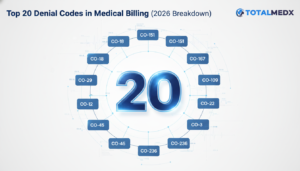
Top 20 Denial Codes in Medical Billing (2026 Breakdown)
Below is a detailed explanation of the most common insurance claim denial reasons in U.S. medical billing.
1. CO-16 Claim Missing or Incomplete Information
CO-16 is one of the most frequent denial codes in healthcare billing.
It occurs when required claim information is missing or incomplete.
Common issues include:
- Missing patient demographics
- Incomplete CPT or ICD-10 codes
- Incorrect provider identification
- Missing modifiers
This denial is often caused by front-end data entry errors and is highly preventable with proper validation systems.
2. CO-18 Duplicate Claim Submission
This denial occurs when a claim is submitted more than once for the same service.
Common causes:
- Lack of a claim tracking system
- Manual resubmission errors
- Clearinghouse duplication
- System glitches in billing software
Duplicate claims create unnecessary administrative burden and delay reimbursement.
3. CO-29 Timely Filing Limit Exceeded
Insurance payers enforce strict filing deadlines. If a claim is submitted after the allowed timeframe, it is automatically denied.
Key causes:
- Delayed documentation
- Inefficient billing workflows
- Lack of timely submission tracking
Timely filing denials are one of the most preventable revenue losses in medical billing.
4. CO-50 Non-Covered Services
This denial occurs when the service provided is not covered under the patient’s insurance plan.
Examples:
- Cosmetic procedures
- Experimental treatments
- Excluded plan benefits
Proper insurance verification before service delivery is essential to avoid this denial.
5. CO-97 Included in Global Package
Many procedures are bundled into a global payment structure. Billing separately results in denial.
Common in:
- Surgical procedures
- Post-operative care
- Facility billing packages
Understanding bundling rules is essential for accurate reimbursement.
6. CO-109 Incorrect Payer Submission
This denial occurs when claims are submitted to the wrong insurance payer.
Causes include:
- Outdated insurance records
- Coordination of benefits errors
- Eligibility verification failure
Front-end insurance validation reduces this issue significantly.
7. CO-22 Coordination of Benefits Error
Occurs when multiple insurance providers are involved, but the proper billing order is not followed.
Common issues:
- Incorrect primary insurance assignment
- Missing COB information
- Outdated patient insurance profiles
8. CO-96 Service Not Covered
This denial indicates that the billed service is not covered under the payer policy.
It often results from:
- Policy exclusions
- Incorrect coding
- Lack of medical necessity documentation
9. CO-151 Prior Authorization Missing
One of the most impactful denial codes in U.S. healthcare billing.
If prior authorization is not obtained, the claim is automatically denied.
Common services:
- Imaging procedures
- Specialty treatments
- Surgical procedures
10. CO-167 Diagnosis Does Not Support Service
Occurs when ICD-10 diagnosis codes do not justify the procedure performed. This highlights the importance of accurate medical coding compliance.
11. CO-45 Charges Exceed Contracted Rate
Insurance companies deny claims when billed amounts exceed the allowed fee schedules.
12. CO-204 Service Not Separately Payable
This denial occurs when services are included in a bundled procedure.
13. CO-197 Missing Authorization
Similar to CO-151, but often applies to specific procedure types or payer policies.
14. CO-252 Administrative Denial
This includes:
- Missing documentation
- Incorrect claim formatting
- Submission errors
These are fully preventable with structured workflows.
15. CO-16 (Recurring Data Errors)
Despite improvements in digital systems, CO-16 remains a leading cause of claim rejection due to human entry errors.
16. CO-18 (System-Level Duplication)
Often caused by poor claim lifecycle tracking and system integration issues.
17. CO-50 (Coverage Limitation)
Occurs frequently in specialty care billing, where coverage rules vary widely.
18. CO-97 (Bundling Complexity Issues)
Common in surgical billing and advanced procedural coding.
19. CO-109 (Eligibility Mismatch Errors)
Caused by outdated or incorrect insurance data in patient records.
20. CO-22 (COB Failures in Complex Insurance Cases)
Remains a major challenge in multi-payer coordination environments.
Root Causes of Medical Billing Denials in the U.S.
Most medical claim denials originate from a few core operational weaknesses:
- Inaccurate patient intake
- Coding errors (ICD-10 / CPT mismatches)
- Missing prior authorization
- Insurance eligibility failures
- Weak revenue cycle workflows
- Lack of payer rule updates
A significant portion of these denials is preventable with structured revenue cycle systems like those implemented by TotalMedx, which focuses on improving clean claim submission rates and reducing AR backlog.
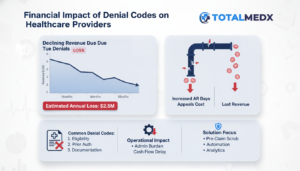
Financial Impact of Denial Codes on Healthcare Providers
Denials directly affect healthcare revenue in multiple ways:
- Delayed payments
- Increased administrative costs
- Higher accounts receivable aging
- Revenue leakage from unworked claims
- Reduced net collection rates
Even a small reduction in denial rates can significantly improve financial performance for healthcare organizations.
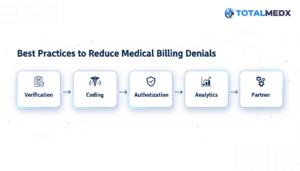
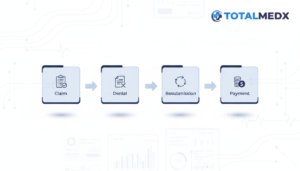
A 5-step process for healthcare providers to minimize claim denials and optimize revenue cycles.
Best Practices to Reduce Medical Billing Denials
Improve Front-End Eligibility Verification
Accurate insurance verification prevents CO-16 and CO-109 denials.
Strengthen Medical Coding Accuracy
Proper ICD-10 and CPT coding reduces CO-167 and CO-96 denials.
Implement Prior Authorization Tracking
Prevents CO-151 and CO-197 denials.
Use Denial Analytics
Identifies patterns in insurance claim denial reasons and improves decision-making.
Partner with Revenue Cycle Experts
Organizations like TotalMedx specialize in reducing denial rates through structured billing optimization and workflow redesign.
Future of Denial Management in 2026
The future of revenue cycle management in healthcare is moving toward:
- AI-driven claim validation
- Predictive denial prevention systems
- Real-time eligibility verification
- Automated coding assistance
- Intelligent denial routing systems
Healthcare organizations that adopt proactive denial prevention strategies will outperform those relying on reactive billing processes.
Conclusion
Understanding top denial codes in medical billing is essential for improving financial performance in U.S. healthcare organizations. These codes are not just rejection messages; they are indicators of system inefficiencies and revenue leakage points.
Most claim denials are preventable when healthcare providers adopt structured workflows, accurate coding practices, and real-time verification systems.
With specialized expertise in medical billing denial management, companies like TotalMedx help healthcare organizations reduce errors, improve clean claim rates, and optimize revenue cycle efficiency.
Frequently Asked Questions (FAQs)
1. What are denial codes in medical billing?
Denial codes are standardized reasons provided by insurance companies explaining why a medical claim was not paid or was rejected.
2. What is the most common denial code in healthcare billing?
CO-16 (missing information) and CO-18 (duplicate claim submission) are among the most frequent denial codes in the U.S.
3. Can denied claims be resubmitted?
Yes, many denied claims can be corrected and resubmitted within the payer’s allowed timeframe.
4. What causes most medical billing denials?
The most common causes include eligibility errors, coding mistakes, missing authorization, and documentation gaps.
5. How does TotalMedx help reduce claim denials?
TotalMedx improves revenue cycle performance by optimizing billing workflows, reducing coding errors, and strengthening denial management systems.